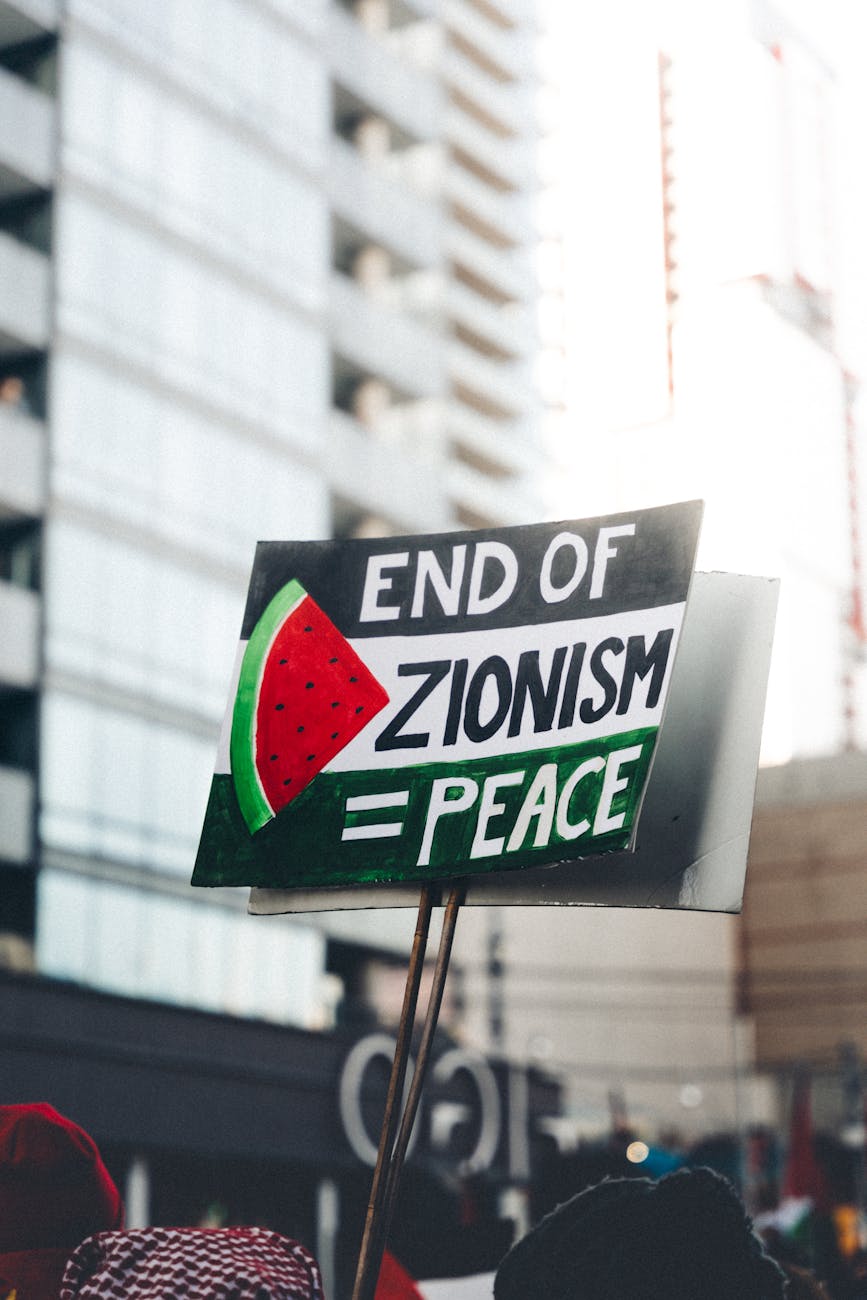
For much of the twentieth century, overt antisemitism became morally radioactive in educated Western society. After the Holocaust, explicit anti-Jewish rhetoric carried a stigma that few public movements wished to own. The old language of Jewish greed, Jewish conspiracy, or Jewish disloyalty became increasingly disreputable outside extremist circles.
Yet political hostility toward Jews did not disappear.
In many cases, it changed its vocabulary.
By the late twentieth century, especially within segments of the international left, anti-Zionism emerged as the preferred moral framework through which anti-Jewish suspicions could be expressed while retaining the language of anti-racism, anti-colonialism, and human rights.
This is not to say that every criticism of Israel is antisemitic. States may be criticized like any other state. Policies may be condemned like any other policies.
The historical issue is more specific — and more serious:
how Jewish national self-determination came to be treated as uniquely illegitimate, uniquely malignant, and uniquely symbolic of global injustice.
That transformation did not happen spontaneously. It was politically constructed over decades through Soviet propaganda, United Nations rhetoric, Third World revolutionary discourse, and the New Left’s moral framework of oppressor versus oppressed.
Understanding that construction is essential if one wants to understand why anti-Jewish themes now so often appear in the respectable language of anti-Zionism.
Readers seeking the full two-century political chronology behind this ideological shift can find the complete documented account on Amazon here: https://www.amazon.com/dp/B0GZHZ1P9Y
Before 1967: Zionism Was Not Yet the Universal Villain
In the years surrounding the creation of Israel in 1948, Zionism was not uniformly demonized across the global left.
Many socialists actually admired aspects of the Zionist project:
- kibbutz collectivism,
- labor organization,
- agricultural socialism,
- anti-imperial self-assertion.
Even the Soviet Union initially backed the UN partition plan, hoping the emergence of a Jewish state might weaken British influence in the region.
This matters because it shows anti-Zionism was not an automatic left-wing reflex.
It had to be manufactured.
And the turning point came after the Six-Day War.
1967 and the Political Recasting of Israel
Six-Day War transformed the geopolitical image of Israel almost overnight.
Before 1967, many viewed Israel as a precarious refuge surrounded by hostile armies. After its rapid military victory, the optics changed dramatically. Israel increasingly appeared not as vulnerable David but as armed regional power.
This visual shift coincided with a larger ideological shift inside global radical politics.
The New Left was reorganizing moral legitimacy around a new binary:
- colonizer vs. colonized,
- imperialist vs. liberation movement,
- white power vs. Third World resistance.
Once that binary hardened, Israel was gradually slotted into the role of settler-colonial aggressor, while Palestinian nationalism was elevated as an emblem of anti-imperial struggle.
The moral categories became self-reinforcing.
To support Palestinian revolution increasingly meant to oppose Zionism not merely as one nationalism among many, but as a uniquely illegitimate nationalism.
The Soviet Union’s Propaganda Opportunity
No state did more to engineer this shift than the Soviet Union.
After Stalin, Moscow discovered that anti-Zionism offered an extraordinarily useful political instrument. It could:
- weaken Western alliances,
- cultivate Arab partners,
- appeal to Third World anti-colonial sentiment,
- and continue older anti-Jewish suspicion under a new international vocabulary.
Soviet media, pamphlets, intelligence fronts, and diplomatic channels aggressively depicted Zionism as:
- racist,
- fascist,
- expansionist,
- capitalist,
- genocidal,
- globally manipulative.
The rhetorical excess was astonishing.
Zionism was no longer merely criticized as a nationalist project. It was portrayed as the concentrated embodiment of nearly every political evil the revolutionary left opposed.
This was a crucial ideological innovation.
Classical antisemitism had often treated Jews as secret engines of finance and power.
Soviet anti-Zionism now treated the Jewish state as the public engine of imperialism and racism.
The target changed from Jew to Zionist.
The emotional structure remained highly familiar.
“Zionism Is Racism”: The Global Legitimization of a Narrative
The campaign reached international climax in 1975 with United Nations General Assembly Resolution 3379, which declared that “Zionism is a form of racism and racial discrimination.”
This was more than diplomatic theater.
It gave anti-Zionist hostility moral certification.
Once Zionism was formally classified as racism, opposition to Jewish national self-determination no longer appeared prejudicial. It appeared humanitarian.
That changed the emotional posture of anti-Jewish politics in progressive spaces.
People could now participate in rhetoric that singled out the Jewish state for obsessive condemnation while sincerely believing themselves anti-racist.
The stigma attached to antisemitism was bypassed by transferring the entire accusation onto Zionism.
In effect:
the Jew became acceptable to attack so long as he appeared as Zionist.
When Criticism Becomes a Double Standard
Again, criticism of Israel is not inherently antisemitic.
The relevant historical question is one of pattern.
Anti-Zionism crosses into anti-Jewish territory when:
- Jewish nationalism alone is treated as uniquely illegitimate among the world’s nationalisms,
- Israel alone becomes the obsessive symbolic center of global injustice,
- Jewish collective self-defense is described as inherently racist,
- Jews worldwide are pressured to politically disavow Zionism as a condition of moral acceptance.
At that point, Zionism is no longer functioning merely as a foreign policy disagreement.
It becomes a proxy vessel into which much older discomforts about Jewish power, Jewish collective identity, and Jewish legitimacy are poured.
The language sounds modern.
The suspicion is old.
The New Left and the Moral Hierarchy of Victimhood
By the late twentieth century, the New Left’s oppressor/oppressed framework made this dynamic even more powerful.
Political innocence became increasingly allocated according to perceived victim status. Movements classified as anti-colonial acquired moral prestige. Movements classified as Western, militarized, or institutionally successful acquired moral suspicion.
Because Israel was militarily competent, economically resilient, and aligned with the United States, Jewish claims to vulnerability often ceased to register in many activist spaces.
Instead, Jews were increasingly read through structures of:
- whiteness,
- power,
- settler identity,
- institutional influence.
This had a profound downstream consequence:
antisemitism against Jews could be minimized precisely because Jews no longer fit the preferred visual category of victim.
Thus anti-Zionist rhetoric became uniquely attractive as a language through which hostility could be directed at Jews while preserving the self-image of anti-racist activism.
Why Many Jews Experience This as Something Older Than Policy Critique
Many Jews who encounter extreme anti-Zionist discourse describe a familiar sensation:
the subject seems to exceed Israel.
The rhetoric quickly expands into:
- accusations of Jewish money influence,
- accusations of Jewish media manipulation,
- suspicion of Jewish institutional lobbying,
- demands for Jewish political confession,
- denial of Jewish historical vulnerability.
That escalation is not accidental.
Once Zionism is treated not as one debatable national movement but as the concentrated essence of racism, colonialism, and oppression, Jews associated with it become morally contaminated by extension.
This is why anti-Zionist spaces often reproduce atmospheres recognizable to Jews long before any discussion of specific Israeli policy begins.
The conversation may start with borders.
It often ends with Jewish legitimacy.
This modern anti-Zionist framework did not emerge in a vacuum; it sits atop a much longer history stretching from Marxist suspicion to Soviet ideological engineering. The full chronology is documented in the Amazon edition here: https://www.amazon.com/dp/B0GZHZ1P9Y
Why the Distinction Matters
Some readers resist this argument because they fear it shields Israel from criticism.
It does not.
Healthy democratic criticism is normal.
What must be confronted, however, is the way criticism can mutate into a political obsession that uniquely moralizes Jewish national existence.
When no other people’s self-determination is subjected to the same existential scrutiny…
when no other conflict functions as the mandatory litmus test of global conscience…
when Jews are repeatedly asked to renounce their collective attachments in order to remain acceptable…
one is no longer dealing with ordinary policy disagreement.
One is dealing with an ideological tradition that has learned to speak in morally approved language.
Conclusion
Anti-Zionism became the acceptable language of modern antisemitism not because all anti-Zionists consciously hate Jews, but because anti-Zionism provided a historically effective vocabulary through which anti-Jewish suspicions could be re-expressed without triggering the social taboo attached to explicit antisemitism.
It allowed hostility to migrate:
from Jew to Zionist,
from race to colonialism,
from conspiracy to lobbying,
from religious prejudice to human-rights rhetoric.
The migration changed the surface.
It did not always change the underlying emotional structure.
That is why so many Jews hear in contemporary anti-Zionist absolutism something older than foreign policy criticism.
Historically speaking, they are often hearing correctly.
For the full documented history from Marx, Stalin, Soviet propaganda, and the New Left to today’s activist politics, see the complete book on Amazon here: https://www.amazon.com/dp/B0GZHZ1P9Y
Frequently Asked Questions About Anti-Zionism and Antisemitism
Is all anti-Zionism antisemitic?
No. Criticism of Israeli government policy is not automatically antisemitic. The issue arises when Jewish national self-determination is uniquely demonized or Jews are collectively stigmatized through Zionism.
What does “Zionism is racism” mean?
It refers to the Cold War political campaign culminating in the 1975 UN resolution that declared Zionism a form of racism, helping legitimize anti-Zionist hostility worldwide.
Did the Soviet Union promote anti-Zionism?
Yes. The Soviet Union aggressively used anti-Zionist propaganda after 1967 to attack Israel, weaken Western alliances, and continue anti-Jewish suspicion under ideological language.
Why do many Jews connect anti-Zionism to antisemitism?
Because anti-Zionist rhetoric often expands beyond Israeli policy into suspicion of Jewish power, Jewish loyalty, Jewish institutions, and Jewish collective legitimacy.
Can someone criticize Israel without being antisemitic?
Absolutely. Legitimate criticism focuses on policies and actions. It becomes suspect when Israel is treated as uniquely evil or Jewish identity becomes morally conditional.
Leave a Reply