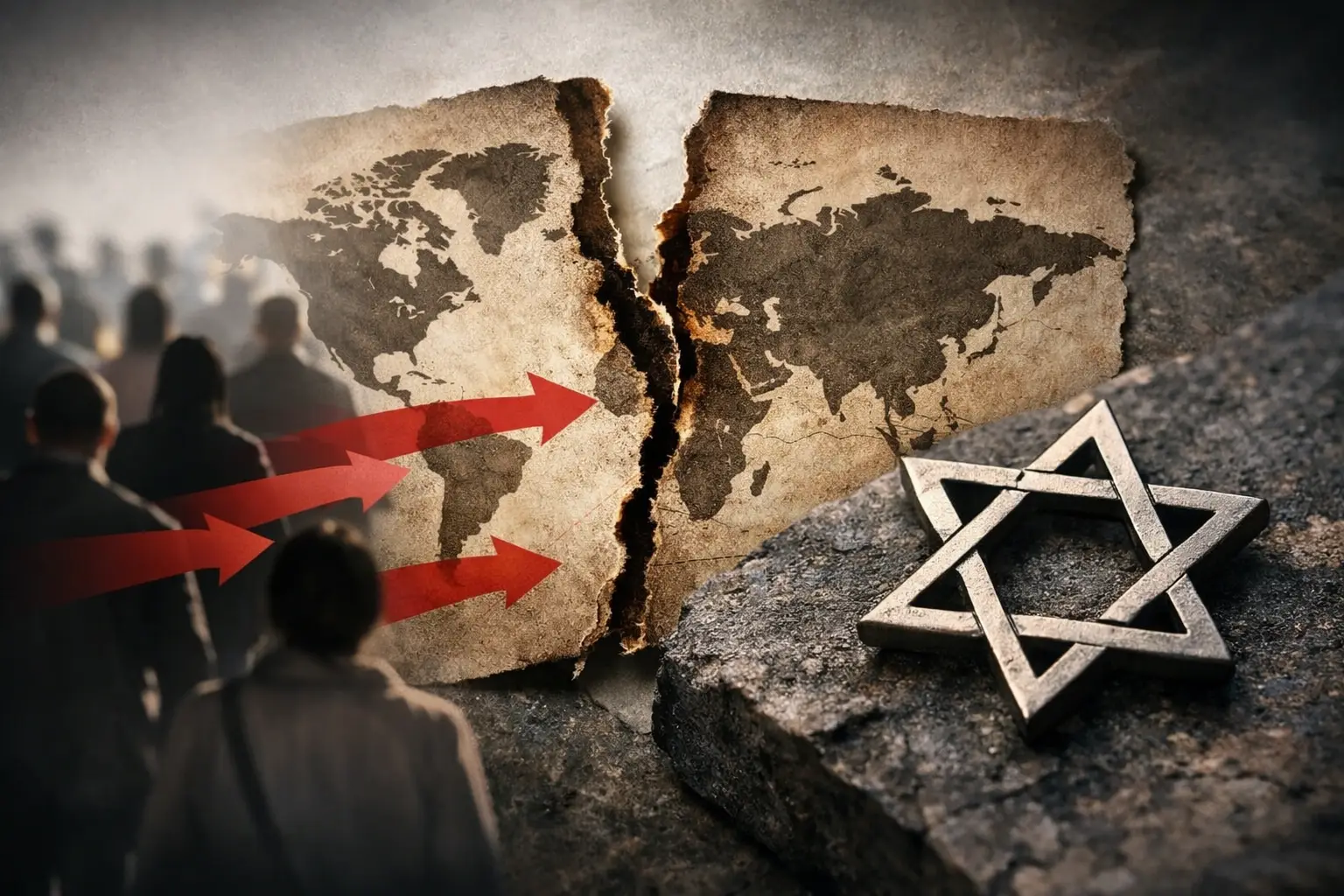
The phrase “Great Replacement” presents demographic change as a covert project: a native population is allegedly being displaced, not through ordinary migration, birth rates, policy disagreements, or economic pressures, but through intentional coordination by powerful elites. The Great Replacement’s antisemitic roots matter because this structure has rarely remained an abstract theory of population. Again and again, it has supplied a hidden organizer, and Jews have been cast in that role.
This does not mean that every person concerned about immigration, integration, or national cohesion endorses antisemitism. Those are legitimate subjects of democratic debate. The distinguishing feature of replacement ideology is its conspiratorial claim that demographic change is centrally directed by an enemy acting against “the people.” Once that claim is accepted, older antisemitic narratives become readily available: Jewish control of finance, media, migration policy, revolutionary movements, and political institutions.
Great Replacement Antisemitic Roots Before the Phrase
The contemporary label is recent. Renaud Camus popularized “Great Replacement” in France during the early twenty-first century, portraying immigration from North Africa and the Middle East as the replacement of France’s historic population. Yet the underlying intellectual machinery is much older. It developed through nineteenth- and twentieth-century racial nationalism, colonial anxieties, eugenics, and antisemitic conspiracy literature.
European nationalist movements often treated Jews as a uniquely destabilizing force: a people said to be both alien and unusually powerful, at once rootless cosmopolitans and secret architects of national decline. This contradiction was not a flaw in the theory. It made Jews useful as a universal explanation for developments that alarmed reactionaries – urbanization, capitalism, secularization, liberalism, socialism, and migration.
The forged Protocols of the Elders of Zion, first circulated in the Russian Empire in the early twentieth century, gave this worldview one of its most durable scripts. It alleged a Jewish plan to control governments, newspapers, finance, and public opinion. Though repeatedly exposed as a fabrication, the Protocols supplied a narrative template that outlived the document itself: social change is not contingent or contested; it is designed. The public cannot see the design because Jews, or Jewish proxies, conceal it.
Nazi propaganda fused this conspiratorial antisemitism with racial panic. Jews were depicted as responsible for mutually incompatible threats: capitalist exploitation and Bolshevik revolution, liberal decadence and revolutionary disorder, national weakness and international power. Such claims did not describe reality. They organized grievance by identifying a supposedly omnipotent enemy behind every unwelcome transformation.
Postwar public life made explicit racial antisemitism less respectable in many settings, but it did not eliminate the narrative structure. It migrated into coded language about globalists, international bankers, cultural Marxists, and elites engineering the destruction of nations. The labels changed; the explanatory function often did not.
From “White Genocide” to Replacement Theory
The direct bridge to present-day replacement politics is visible in the “white genocide” myth. This idea alleges that immigration, interracial marriage, changing cultural norms, and lower birth rates among white populations are parts of a deliberate campaign to eliminate white people. It was advanced by openly neo-Nazi figures, including David Lane, whose “Fourteen Words” became a staple of white supremacist organizing.
“White genocide” was never a demographic analysis. It was an accusation of intent. Population change, however uneven or politically contentious, was reimagined as extermination. That vocabulary supplied an emotional escalation that has proved consequential: if migration is genocide, then ordinary political compromise becomes betrayal and violence can be rationalized as self-defense.
The Great Replacement theory sometimes uses less explicit racial terminology, referring instead to culture, civilization, or indigenous populations. That rhetorical adjustment can make it appear more acceptable to wider audiences. But the core claim remains familiar: demographic shifts are purposeful, hostile, and directed from above. In its most radical forms, the alleged planners are named as Jews. In more guarded versions, Jewish names and institutions are invoked through implication.
The targeting of George Soros illustrates the mechanism. Criticism of any wealthy donor, foundation, or policy advocate is not inherently antisemitic. The line is crossed when a Jewish individual is made to stand for a global system of covert control – when migration, elections, protest movements, public health, criminal justice, and media institutions are all attributed to one malign financier. This is not serious institutional analysis. It is the old fantasy of Jewish power adapted to contemporary political language.
Why the Conspiracy Travels Across Political Boundaries
Replacement rhetoric is most visible in far-right politics, but its antisemitic logic should not be treated as a problem confined to one camp. Conspiracy theories travel because they simplify complex social realities and offer moral certainty. They identify a single agent responsible for outcomes produced by many forces: war, labor markets, colonial legacies, housing policy, climate displacement, family choices, and electoral decisions.
On the left, parallel habits can appear when “Zionists” are treated not as supporters of a range of views about Jewish national self-determination, but as a secret transnational force controlling governments, media, police, finance, or migration. Here the political vocabulary differs, but the structure can resemble older antisemitic thought: Jews are made uniquely influential, uniquely disloyal, and uniquely responsible for systems of power.
This comparison requires care. Opposition to Israeli government policy is not antisemitism, and neither is criticism of nationalism or immigration policy. The question is whether the argument relies on evidence, specific institutions, and accountable actors, or whether it turns Jews or “Zionists” into an all-purpose explanation for political events. A theory that can explain every outcome by reference to an unseen Jewish network has ceased to be analysis.
The same caution applies to claims about the Great Replacement. Governments do make immigration laws. Businesses seek labor. Advocacy groups campaign for particular policies. Citizens disagree profoundly about borders, asylum, and integration. Those facts call for empirical arguments and democratic contestation. They do not establish a unified plot to erase a people.
The Digital Afterlife of an Older Myth
Online platforms have helped replacement theory move between openly extremist spaces and mainstream political conversation. A meme may avoid the word “Jew,” yet pair references to “globalists,” demographic decline, and media manipulation with images or names long associated with antisemitic conspiracism. Other posts use irony, quotation marks, or “just asking questions” to preserve deniability while directing audiences toward a familiar conclusion.
This ambiguity is politically useful. It permits speakers to deny antisemitic intent while benefiting from an audience that understands the coded reference. It also makes criticism easier to dismiss as censorship or bad faith. But interpretation should attend to patterns, not merely isolated words. Repeated claims that shadowy elites are importing migrants, suppressing national identity, and controlling public institutions belong to a recognizable historical repertoire.
The violent consequences are not hypothetical. The 2018 Pittsburgh synagogue attack was motivated by the gunman’s belief that Jews were facilitating an “invasion” of the United States. The 2019 Christchurch attacker’s manifesto used replacement language. These crimes do not mean that every exposure to the theory produces violence. They show, rather, how a demographic conspiracy can turn a synagogue, a mosque, a migrant community, or a Jewish public figure into a target when collective paranoia becomes a politics of emergency.
A Standard for Serious Discussion
A responsible discussion of demographic change begins by rejecting both taboo and fantasy. It should be possible to debate immigration levels, refugee policy, social integration, religious freedom, and national identity without alleging a clandestine campaign against a racial or religious population. It should also be possible to identify antisemitic conspiracy patterns without pretending that all political concerns about migration are illegitimate.
The essential test is straightforward. Who is alleged to be acting? What evidence establishes coordination? Are institutions being analyzed in their actual roles, or are disparate events being gathered into a story of hidden control? And when the purported organizers are Jews, Jewish donors, or “Zionists,” does the argument reproduce the age-old image of Jewish collective power?
Historical literacy cannot prevent every recycled lie from finding an audience. It can, however, make the lie harder to pass off as a new insight. When demographic anxiety is converted into a conspiracy of Jewish control, the task is not to soften the diagnosis. It is to insist that political argument meet the standards of evidence, specificity, and human equality it so often claims to defend.
Leave a Reply