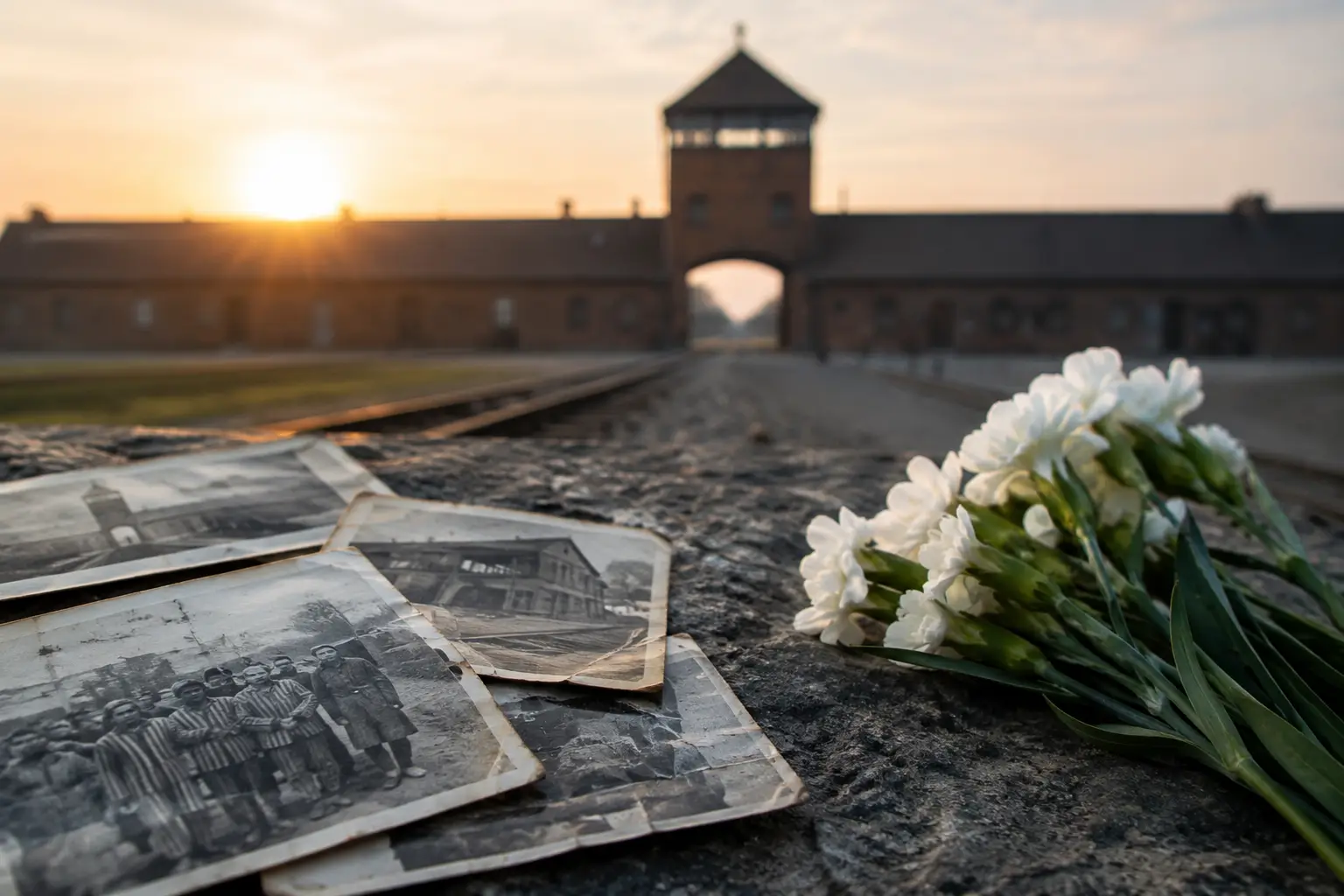
Holocaust distortion versus denial is not a dispute over terminology. The distinction identifies two related methods of falsifying the Nazi genocide: one denies that the crime occurred as documented; the other concedes enough of the record to recast its meaning, scale, perpetrators, victims, or aftermath. Both corrode historical understanding. Both also have political uses, especially where movements wish to present antisemitism as a marginal concern, an invented accusation, or an understandable reaction to Jewish power.
Holocaust denial rejects the historical record
Holocaust denial claims that Nazi Germany did not systematically murder six million Jews; that gas chambers were nonexistent or insignificant; that documentary, forensic, and survivor evidence is fabricated; or that the Nazi regime pursued deportation rather than extermination. Such claims have been repeatedly refuted by an immense body of evidence: Nazi records, camp architecture, German perpetrator testimony, demographic data, photographs, intercepted communications, postwar trials, and survivor accounts.
Denial often presents itself as skeptical inquiry. Its advocates ask selective questions about documents or technical details, then treat any uncertainty in a vast historical record as grounds to dismiss the record altogether. This is not ordinary revisionism. Historical scholarship revises interpretations in light of evidence. Denial begins with a political conclusion and searches for fragments that can be made to serve it.
The ideological origins of postwar denial were rarely obscure. It circulated among former Nazis, fascist networks, and conspiratorial antisemites who understood that acknowledging the Holocaust made open rehabilitation of Nazism difficult. If Jews could be portrayed as having invented or exaggerated their own destruction, antisemitic conspiracy theories could be revived in a new form. The alleged fraud itself became evidence, in deniers’ imagination, of Jewish manipulation.
Holocaust distortion changes what the Holocaust means
Holocaust distortion is broader and often more socially acceptable because it does not always require an explicit denial of mass murder. It can minimize Jewish victimhood, blur the specifically antisemitic purpose of Nazi policy, falsely equate perpetrators and victims, or turn the Holocaust into a generic lesson detached from Jews and from Nazi ideology.
Distortion may appear in claims that all groups suffered identically under Nazism, as though the attempted annihilation of Europe’s Jews were merely one hardship among many. Roma, disabled people, Poles, Soviet prisoners of war, gay men, political opponents, and others were indeed persecuted and murdered by the Nazi regime. Recognizing this is essential. But historical accuracy requires recognizing differences in policy and intent. The Nazis pursued the Jews across borders, defined Jewishness through racial law and ancestry, and built a continent-wide machinery intended to eliminate every Jew within their reach.
Other forms of distortion treat the Holocaust as a moral currency that can be redistributed at will. The genocide becomes a rhetorical device used to accuse Jews of exploiting suffering, to deny Jewish people a place in the history of antisemitism, or to insist that attention to the Holocaust is itself evidence of ethnic favoritism. Such arguments do not always deny the death camps. They instead resent the fact that the crimes happened to Jews and that Jews remember them.
False equivalence is not historical comparison
Comparison can be indispensable to historical study. It helps explain how regimes classify enemies, normalize violence, mobilize bureaucracy, and conceal mass murder. But comparison becomes distortion when it erases proportion, context, or agency.
Equating the Holocaust with every contemporary injustice does not elevate concern for victims. More often, it trivializes both events. A historical analogy should clarify a specific feature of a case and remain open to disconfirmation. A slogan that labels any disliked government, institution, or political opponent “Nazi” usually does the opposite. It converts history into invective and makes the actual Nazi project harder to describe.
The same problem arises when Israel-related debate uses Holocaust imagery to invert Jews into Nazis or to suggest that Jewish memory of genocide is proof of moral hypocrisy. Criticism of Israeli policy is not Holocaust distortion merely because it is severe. The relevant question is whether the language preserves historical reality or uses Nazi analogies to degrade Jews collectively, negate Jewish historical experience, or cast Jewish national self-determination as uniquely criminal.
Why the distinction matters in political movements
Denial is easier to identify because it makes claims that can be directly checked against evidence. Distortion can travel farther because it often borrows the vocabulary of human rights, anti-racism, or universalism. A speaker may affirm that the Holocaust occurred while implying that Jews exploit it, that antisemitism ended in 1945, or that contemporary hostility toward Jews is politically insignificant compared with every other prejudice.
This is particularly consequential within parts of the political left. Movements committed to equality are not immune to antisemitic ideas simply because their stated principles reject racism. Historically, some socialist, communist, and anti-imperialist traditions have treated Jews as embodiments of capitalism, cosmopolitan disloyalty, colonial power, or hidden influence. Soviet campaigns against “rootless cosmopolitans,” for example, did not need to deny the Holocaust in order to marginalize Jewish identity and suppress discussion of specifically Jewish suffering under Nazism.
In contemporary settings, distortion may take the form of describing the Holocaust only as a universal warning against fascism while resisting any discussion of antisemitism that complicates a preferred political narrative. It may surface when Jewish concerns are dismissed as bad-faith attempts to silence criticism, or when memorial institutions are expected to address every injustice except the anti-Jewish ideology that made Auschwitz possible.
The issue is not that universal lessons are illegitimate. The Holocaust does illuminate the dangers of racial conspiracy, state power, bureaucratic dehumanization, and public indifference. But universal lessons become evasive when they require the disappearance of Jews as Jews. A universalism that cannot name a particular target of persecution is too abstract to protect anyone.
How to recognize distortion without policing debate
Care is needed here. Not every imprecise statement is denial, and not every flawed analogy reflects antisemitic intent. People can be historically uninformed, careless with language, or engaged in good-faith disagreement over interpretation. The task is to assess patterns, claims, and consequences rather than to treat every error as proof of malign motive.
Several questions help establish the difference. Does a claim deny well-established evidence or selectively dismiss sources that contradict it? Does it minimize the Nazi project of exterminating Jews? Does it portray Jewish remembrance as a scheme for power or immunity? Does it employ Nazi comparisons to condemn Jews collectively rather than to analyze a concrete policy? And when the problem is explained, does the speaker correct the record or double down by depicting Jews as censors?
These questions matter because distortion commonly works through accumulation. One misleading comparison may be ignorance. Repeated insinuations that Jews fabricate antisemitism, monopolize victimhood, or learned nothing from the Holocaust form a recognizable political pattern. They shift responsibility away from antisemitic movements and onto Jews who object to being targeted.
Historical precision is a moral discipline
The Holocaust cannot be protected by ritual language alone. It requires precision: about Nazi antisemitism, about the mechanisms of genocide, about the diversity of victims, and about the postwar ideologies that sought to falsify or instrumentalize the past. That precision is not a demand for reverence beyond criticism. It is a refusal to let ideological convenience determine what may be remembered.
For educators, journalists, organizers, and researchers, the standard should be simple but demanding: investigate claims, distinguish comparison from equivalence, and reject conspiratorial explanations even when they arise in politically sympathetic circles. The most useful response to distortion is neither panic nor euphemism. It is careful historical judgment, applied consistently, especially where a movement’s professed commitment to justice makes self-examination most necessary.
Leave a Reply