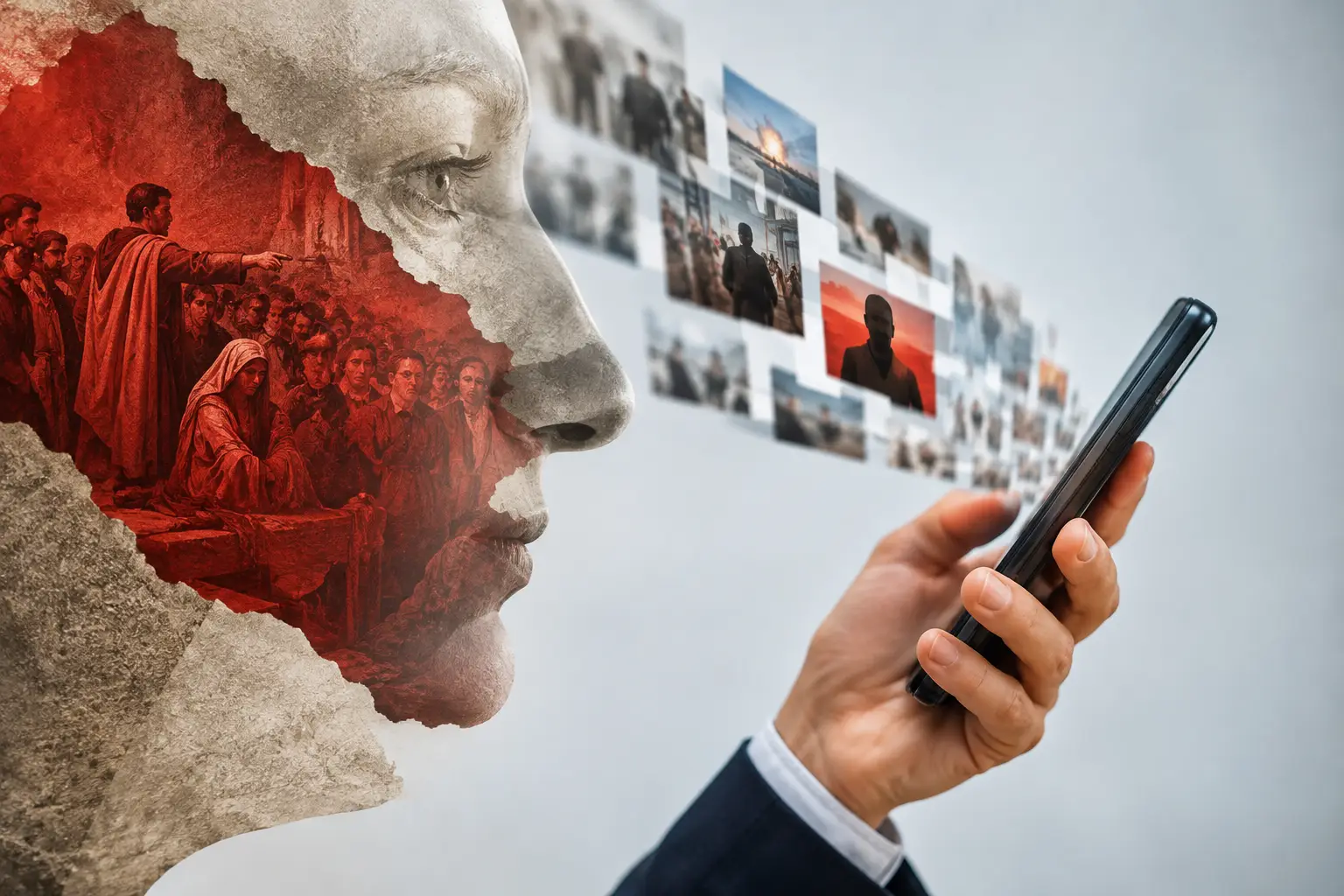
A medieval blood libel did not need to survive in its original religious language to remain politically useful. The central question is how propaganda recycles blood libel: by retaining its moral structure while changing its setting, vocabulary, and alleged victims. Jews are cast not merely as adversaries who commit wrongs, but as a uniquely malicious collective that deliberately preys on innocent children, treats human suffering as a source of gain, and conceals its crimes through unusual power.
This is why contemporary versions can be missed. A poster, chant, cartoon, or viral video may contain no reference to ritual murder, Christianity, or medieval Europe. Yet when it depicts Jews or Israelis as people who kill children for pleasure, consume or profit from blood, steal organs, poison the vulnerable, or coordinate atrocities in secret, it can reactivate one of antisemitism’s oldest and most dangerous narratives.
Blood libel was a theory of Jewish moral monstrosity
The classic blood libel accused Jews of murdering Christian children for ritual purposes, especially around Passover. It appeared in medieval England and spread across Europe through accusations, trials, sermons, images, and local cults built around alleged child martyrs. The charge was false. Its consequences were real: executions, expulsions, mob violence, and the consolidation of a public image of Jews as enemies of the surrounding society.
The accusation did more than allege a crime. It made Jewish identity itself the evidence. A murder committed by an individual can be investigated, disputed, and punished. Blood libel instead attributed an imagined, sacred cruelty to Jews as Jews. It transformed a minority into a collective danger and portrayed ordinary moral restraint as something Jews lacked.
That distinction matters when identifying modern forms. The issue is not whether civilian deaths, military conduct, state policy, or powerful institutions may be criticized. They can and should be examined with evidence, legal standards, and moral seriousness. Blood-libel thinking begins where analysis gives way to a story about an inherently bloodthirsty collective, for whom dead children are supposedly an aim rather than a tragic consequence, a disputed allegation, or a crime requiring proof.
How propaganda recycles blood libel through new language
Modern propaganda rarely reproduces medieval accusations word for word. It borrows their emotional machinery. The first mechanism is the image of predation: Jews are represented as hunters of children, vampires, monsters, or figures who delight in suffering. The second is collective guilt: an action attributed to a government, army, institution, or individual becomes proof of what “the Jews” are. The third is concealment: Jews are said to control media, governments, courts, or public memory so completely that only the propagandist can reveal the supposedly hidden truth.
These elements often appear together. An unverified claim of child murder is circulated with graphic imagery. Doubts about the claim are then presented as proof that Jews or Israel have silenced the press. The allegation becomes self-sealing: evidence is unnecessary because the absence of evidence is recast as evidence of conspiracy.
This pattern has taken secular forms for more than a century. Antisemitic movements adapted older Christian charges to the language of race, finance, revolution, imperialism, and national betrayal. Nazi propaganda used images of Jewish bodily corruption and predation alongside claims that Jews were directing both capitalism and Bolshevism. The contradiction did not weaken the myth. Its purpose was not coherence, but the construction of a universal enemy capable of explaining every social wound.
Soviet propaganda also demonstrated how an officially anti-racist political culture could reproduce antisemitic structures. Under Stalin, campaigns against alleged “rootless cosmopolitans” and later accusations surrounding the Doctors’ Plot mobilized themes of disloyalty, secret coordination, and Jewish malice behind professional or political masks. The language was often coded, but the target was widely understood. A movement’s declared commitment to equality is not a safeguard when it refuses to recognize antisemitic patterns in its own rhetoric.
The child-image is not incidental
Children occupy a special place in blood-libel propaganda because they make moral judgment feel immediate. Images of injured or dead children can rightly produce grief, anger, and demands for accountability. Propaganda exploits that response by attaching an absolute explanation to the image before facts are established.
The recurrent claim is not simply that children have been harmed in war. It is that Jews, Israelis, or Zionists seek their deaths, enjoy them, require them, or systematically target them because of a distinctive collective cruelty. This is an accusation about essence, not policy. It asks audiences to stop distinguishing among leaders, soldiers, civilians, institutions, intentions, evidence, and responsibility.
Visual culture intensifies the effect. Cartoons and memes can revive blood-libel motifs with extraordinary economy: red hands, fanged faces, blood-dripping flags, children offered to grotesque Jewish figures, or imagery that turns Jewish religious symbols into instruments of slaughter. Such material may be defended as political art. Context matters, but so do symbols and historical memory. Repetition of a known antisemitic grammar is not neutral simply because it appears in a contemporary conflict.
The political value of the recycled accusation
Blood libel is especially useful to propagandists because it converts a difficult political reality into a simple moral drama. Wars and national conflicts involve competing claims, unequal power, trauma, civilian suffering, propaganda by multiple actors, and facts that may take time to establish. The blood-libel frame eliminates that complexity. It supplies a villain whose guilt is total and whose humanity need not be considered.
For movements organized around liberation, this creates a severe moral test. Anti-imperialism and anti-racism require attention to power and suffering. But they also require resistance to collective demonization. When activists treat antisemitic imagery as acceptable because the target is called “Zionist,” they risk preserving the old accusation under a political label.
The term Zionist is not inherently antisemitic, and criticism of Zionism is not inherently blood libel. The question is how the word functions in a particular claim. Does it refer to a defined political ideology, government, organization, or policy? Or does it operate as a catch-all substitute for Jews, attributed with occult power, global coordination, a taste for child murder, and immunity from ordinary moral standards? The latter is not careful political critique. It is a familiar antisemitic displacement.
This distinction also protects serious advocacy. Claims about civilian harm need corroboration. Legal accusations require evidence and clear definitions. Journalists and organizers should resist both denial of suffering and the temptation to elevate every shocking claim into unquestionable truth because it serves a preferred political narrative. The standard should not change when Jews are the alleged perpetrators.
What disciplined reading looks like
A useful first question is whether an allegation is specific enough to test. Who is accused? What happened, where, and when? What evidence supports the claim? Is the language describing conduct, or assigning a permanent moral character to an entire people?
A second question concerns symbolic inheritance. Does the rhetoric invoke blood, child sacrifice, vampirism, organ theft, poison, hidden control, or ritualized cruelty? Any one image may require contextual interpretation. A cluster of them, especially when directed at Jews or dressed in the language of Zionism, deserves direct scrutiny rather than evasive reassurance.
Finally, readers should notice double standards. Is the claim treated as established despite weak evidence because it concerns Jews? Are all Jews held answerable for the acts of a state? Is a demand for verification denounced as complicity? Antisemitic propaganda thrives when normal standards of proof are suspended in the name of moral urgency.
The task is not to sanitize political conflict or prohibit grief, anger, and protest. It is to refuse a tradition that turns Jewish people into symbols of human cruelty. That refusal begins with historical literacy: recognizing that an old lie can survive precisely by learning to speak the language of the present.
Leave a Reply