Few political slogans of the twentieth century have had a longer afterlife than three deceptively simple words:
Zionism is racism.
Today the phrase feels familiar, even inevitable, in many activist and diplomatic circles. It often appears as though hostility toward Zionism emerged organically from humanitarian concern for Palestinians or from abstract anti-colonial ethics.
Historically, that is not what happened.
The slogan was not born as a neutral moral insight. It was constructed deliberately through a Cold War alliance of Soviet strategic propaganda, Arab diplomatic pressure, and Third World revolutionary theater. Its purpose was not merely to criticize specific Israeli actions. Its purpose was to delegitimize Jewish national self-determination at the level of international morality.
That distinction matters enormously.
Because once Zionism could be defined not as one nationalist movement among many but as an inherently racist doctrine, opposition to the Jewish state acquired an aura of ethical innocence. One could target Jewish collective legitimacy while claiming the mantle of anti-racism.
This was one of the most politically successful linguistic transformations of the postwar era.
And it continues to shape progressive discourse today.
Readers seeking the full historical chain from Marxist suspicion to Soviet anti-Zionism and modern activist politics can find the complete documented account on Amazon here: https://www.amazon.com/dp/B0GZHZ1P9Y
The World Before the Slogan
To understand the force of “Zionism is racism,” one must remember that the phrase did not arise immediately after the creation of Israel.
In fact, for a brief period, Zionism enjoyed substantial international legitimacy.
The Holocaust had made Jewish statelessness morally visible. The United Nations partition vote of 1947 treated Jewish statehood as one acceptable national solution among others. Even the Soviet Union, seeking to weaken British influence, initially supported partition.
This meant Zionism entered the postwar world not as a pariah ideology but as a recognized nationalist project.
Its transformation into a diplomatic villain therefore required political engineering.
That engineering accelerated after 1967.
The Six-Day War Changes Israel’s Symbolism
Six-Day War altered Israel’s image in the global imagination.
Israel’s swift military victory over surrounding Arab armies did more than change borders. It changed optics.
No longer was Israel seen primarily as a precarious post-Holocaust refuge. It increasingly appeared as a militarily dominant Western-aligned power.
This mattered because the international left was simultaneously reorganizing itself around anti-colonial narratives. Newly decolonized states, revolutionary movements, and Western student radicals were all constructing a moral universe centered on:
- oppressed peoples,
- anti-imperial struggle,
- anti-racist solidarity,
- Third World liberation.
Once that framework hardened, Israel became politically available for recasting:
not as national refuge,
but as colonial outpost.
The Soviet bloc recognized the opportunity immediately.
Why the Soviet Union Needed a New Enemy Language
By the late 1960s, Moscow had several reasons to aggressively attack Israel:
- Israel was aligned increasingly with the United States,
- Arab states were strategic Soviet clients,
- anti-colonial rhetoric gave Moscow access to the developing world,
- and anti-Zionism offered a way to continue anti-Jewish suspicion without overtly violating anti-racist postwar norms.
This last point is often underappreciated.
The Soviet Union had already spent decades cultivating suspicion of Jewish “cosmopolitans,” Jewish intellectuals, and Jewish foreign loyalties. But explicit anti-Jewish campaigns had reputational limits after the Holocaust.
Anti-Zionism solved this problem elegantly.
Instead of denouncing Jews as disloyal, Soviet rhetoric could denounce Zionists as:
- imperial agents,
- racists,
- colonial conspirators,
- bourgeois nationalists.
The moral burden shifted.
The target remained highly contiguous with Jewish collective identity.
Soviet Propaganda Machinery Goes to Work
Soviet newspapers, diplomatic communiqués, intelligence front groups, and international conferences began flooding the world with anti-Zionist literature.
The themes were repetitive and strategic:
- Zionism equals racism,
- Zionism equals fascism,
- Zionism equals apartheid,
- Zionism equals imperial aggression,
- Zionism equals global manipulation.
The language was intentionally maximalist.
Zionism was not merely portrayed as flawed nationalism. It was portrayed as singularly malignant — a uniquely toxic political doctrine requiring global condemnation.
This rhetorical inflation served two purposes:
- it isolated Israel diplomatically,
- it attached moral shame to Jewish nationalism itself.
Soviet bloc delegates then worked tirelessly inside the United Nations to universalize this framing.
The Arab-Soviet-Third World Coalition
The Soviet Union could not have achieved this alone.
It found powerful partners in:
- Arab League diplomacy,
- Non-Aligned Movement states,
- postcolonial African governments,
- Latin American revolutionary circles.
For many of these states, anti-Zionism offered overlapping benefits:
- solidarity with Palestinian nationalism,
- anti-Western positioning,
- domestic revolutionary credentials,
- and participation in the prestige politics of anti-racism.
Thus a broad coalition emerged in which Zionism became the perfect symbolic villain:
Western enough to be anti-imperial,
national enough to be anti-colonial,
Jewish enough to absorb older prejudices.
By the mid-1970s, the campaign had achieved enormous momentum.
UN Resolution 3379: The Diplomatic Canonization of a Slogan
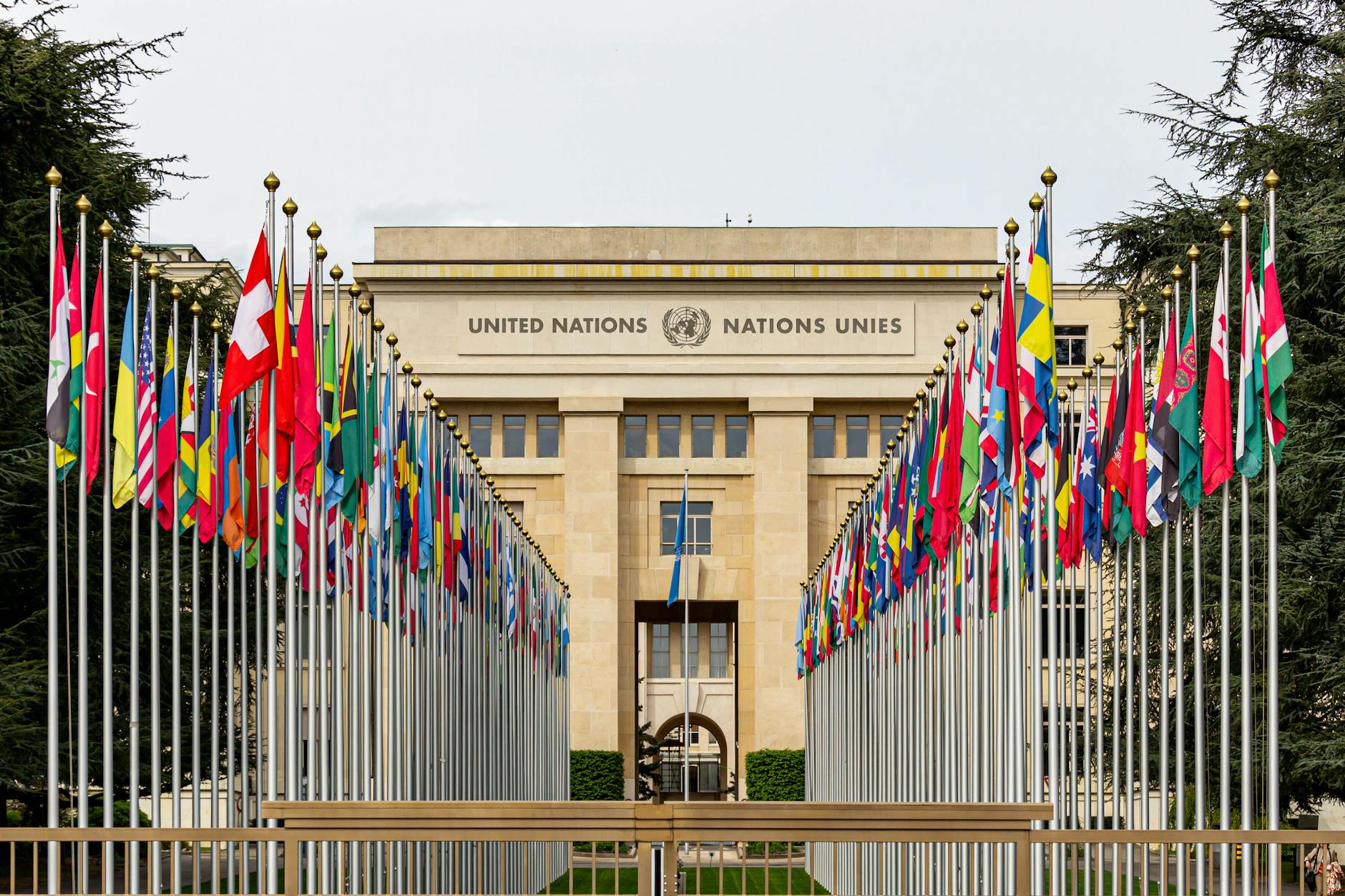
On November 10, 1975, United Nations General Assembly passed United Nations General Assembly Resolution 3379, declaring that “Zionism is a form of racism and racial discrimination.”
This was one sentence.
Its historical consequences were immense.
The resolution did not merely criticize Israeli territorial policy.
It classified the foundational Jewish national movement itself as morally equivalent to racial oppression.
No comparable resolution was passed against dozens of other ethnic nationalisms, authoritarian states, or expansionist regimes.
Jewish self-determination was singled out for categorical condemnation.
That singling out gave anti-Zionist politics something priceless:
international moral legitimacy.
Activists, academics, diplomats, and journalists could now repeat anti-Zionist hostility under the imprimatur of the UN.
The slogan had moved from propaganda to doctrine.
Why “Zionism Is Racism” Was So Politically Powerful
The phrase succeeded because it accomplished several ideological tasks at once.
It inverted Jewish historical memory.
Instead of Jews as victims of racial exclusion, Jews now appeared as perpetrators of racial exclusion.
It converted anti-Jewish hostility into anti-racist activism.
Opposing Jewish nationalism no longer looked prejudicial. It looked virtuous.
It created a universal shorthand.
One did not need to debate the complexities of Middle Eastern history. Merely uttering “Zionism is racism” settled the moral hierarchy instantly.
It detached anti-Zionism from specific policy criticism.
The problem was no longer this or that Israeli government act.
The problem was Zionism as such.
That shift from policy objection to ontological delegitimization is precisely what made the slogan so enduring.
The Resolution Was Repealed — The Moral Framework Was Not
United Nations General Assembly repealed Resolution 3379 in 1991.
Diplomatically, the slogan was withdrawn.
Culturally, it had already won.
By then, two decades of activist education, university discourse, international NGO rhetoric, and media framing had deeply embedded the notion that Zionism was not simply controversial but morally contaminated.
The repeal changed UN paperwork.
It did not undo the ideological inheritance.
To this day, much anti-Israel discourse still relies on assumptions canonized during that 1975 campaign:
- Jewish nationalism as uniquely racist,
- Israel as uniquely colonial,
- Zionism as uniquely incompatible with human rights.
Those assumptions remain the hidden architecture beneath much contemporary progressive anti-Zionism.
The “Zionism is racism” campaign became one of the Soviet bloc’s most successful ideological exports, and its downstream effects continue to shape activist hostility today. The full documented chronology appears in the Amazon edition here: https://www.amazon.com/dp/B0GZHZ1P9Y
Why This Matters Beyond Diplomatic History
Some readers may wonder whether this is merely an old UN procedural story.
It is not.
This was the moment when anti-Jewish hostility learned to wear the universally admired language of anti-racism.
That innovation matters because it changed how prejudice could present itself:
not as hatred,
but as justice;
not as exclusion,
but as liberation;
not as suspicion of Jews,
but as condemnation of Zionists.
This moral laundering made anti-Jewish narratives far more adaptable inside progressive institutions that would never tolerate explicit antisemitism.
The taboo was bypassed.
The hostility survived.
Conclusion
“Zionism is racism” was not an accidental slogan born from neutral humanitarian reasoning. It was a deliberate Cold War construction forged by the Soviet bloc, amplified through UN institutions, and sanctified by anti-colonial revolutionary politics.
Its brilliance lay in its simplicity:
define Jewish self-determination as racism, and opposition to it becomes moral duty.
That formula has outlived the Soviet Union itself.
Today, many who invoke the assumptions behind that slogan have little idea where the framework originated. But they are often speaking inside an ideological house built decades earlier by Moscow, Arab diplomacy, and international activist coalitions.
The phrase sounded like anti-racism.
Historically, it functioned as one of the most effective vehicles for modern anti-Jewish delegitimization.
For the larger documented history linking Soviet propaganda, UN anti-Zionism, and the modern progressive left, see the full book on Amazon here: https://www.amazon.com/dp/B0GZHZ1P9Y
Frequently Asked Questions About “Zionism Is Racism”
What was UN Resolution 3379?
UN Resolution 3379 was a 1975 United Nations General Assembly resolution declaring that Zionism is a form of racism and racial discrimination.
Who pushed the “Zionism is racism” campaign?
The campaign was driven primarily by the Soviet bloc, Arab League states, and a coalition of Third World and Non-Aligned nations during the Cold War.
Why did the Soviet Union attack Zionism?
The Soviet Union used anti-Zionism to weaken Israel, strengthen Arab alliances, promote anti-colonial credentials, and continue anti-Jewish suspicion under ideological language.
Was the “Zionism is racism” resolution repealed?
Yes. The United Nations repealed Resolution 3379 in 1991, but its moral and political framework continued influencing activist discourse.
Why do critics link “Zionism is racism” to antisemitism?
Because it singled out Jewish national self-determination as uniquely illegitimate and helped convert anti-Jewish hostility into the socially acceptable language of anti-racism.
Leave a Reply