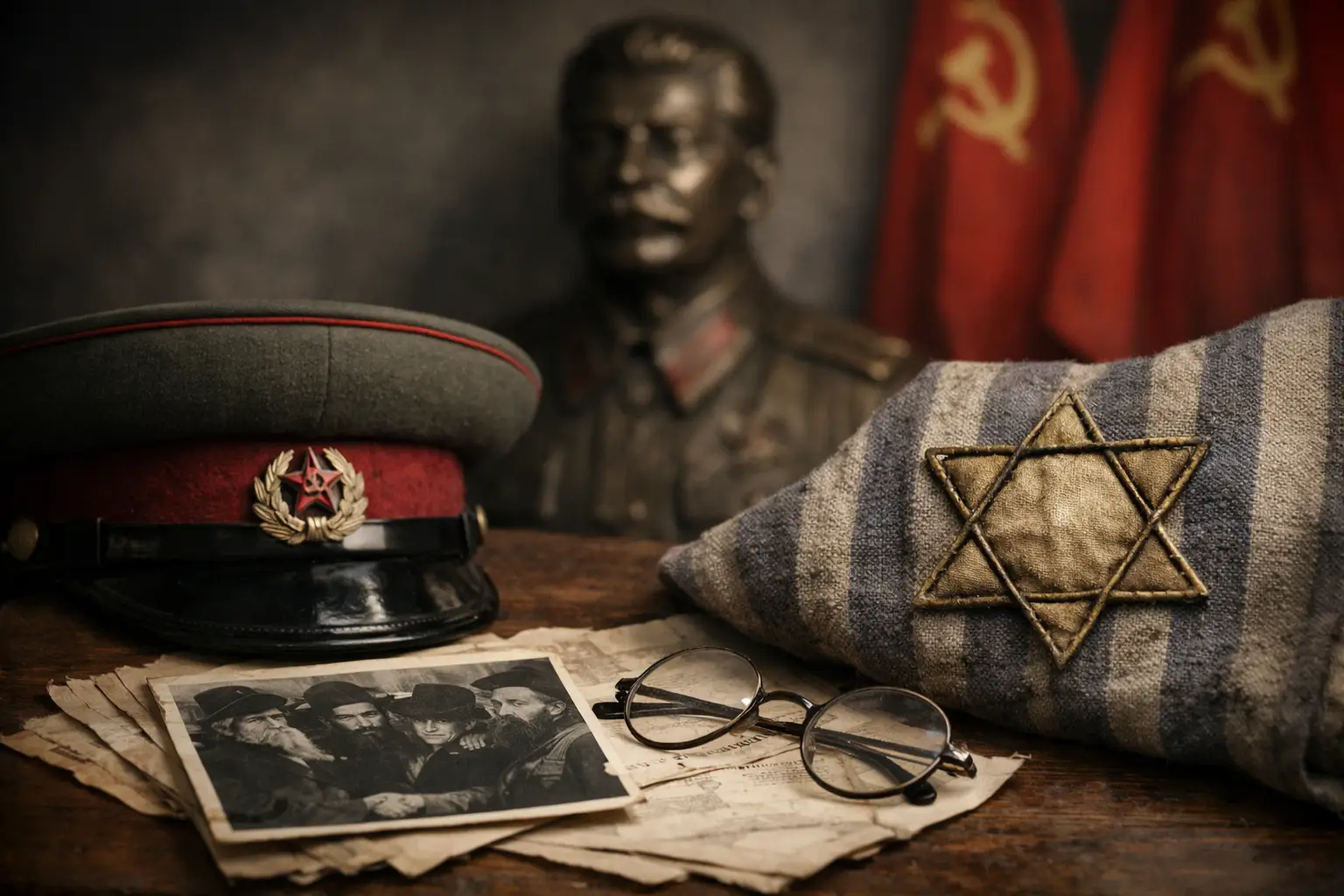
The Soviet antisemitism history cannot be reduced to a single policy, slogan, or dictator. The Soviet state began by denouncing the pogroms and legal discrimination of the tsarist empire. Yet it later built campaigns against supposedly disloyal, cosmopolitan, nationalist, and Zionist enemies in which Jews were repeatedly singled out. The contradiction matters because Soviet leaders presented their system as an uncompromising alternative to racism and nationalism.
That claim gave Soviet antisemitism a distinctive form. It was often expressed not through openly racial language but through the vocabulary of class struggle, state security, anti-religion, and anti-imperialism. Those terms did not automatically make a policy antisemitic. But they could conceal old accusations: that Jews formed a secret network, had divided loyalties, exercised hidden power, or threatened the nation from within.
Revolution Against Pogroms, Not Against Every Prejudice
The Bolsheviks inherited a society scarred by tsarist antisemitism. Jews had been confined to the Pale of Settlement, excluded from many professions and educational institutions, and subjected to recurring violence. During the revolutionary years and civil war, pogroms killed tens of thousands of Jews, committed primarily by anti-Bolshevik forces but also by some Red Army units and other armed groups.
The new Soviet government formally abolished legal restrictions on Jews and publicly condemned antisemitism. Lenin described antisemitism as a weapon used by exploiters to divert workers from class oppression. In the 1920s, the regime also supported secular Yiddish schools, theaters, publishing houses, and research institutions. The Jewish sections of the Communist Party, known as the Yevsektsiya, sought to draw Jewish workers into Soviet life while combating religious and Zionist institutions.
This early record should not be dismissed. For many Jews, Soviet citizenship initially brought real opportunities unavailable under the tsars. But equality was defined on the state’s terms. Jewish religious practice, Hebrew education, independent communal organization, and Zionist political activity were treated as backward, bourgeois, or counterrevolutionary. The distinction between opposing a particular political movement and suppressing Jewish collective life would become increasingly unstable.
Stalin’s Consolidation and the Narrowing of Jewish Life
By the late 1920s, Stalin’s consolidation of power transformed the political environment. The Yevsektsiya was dissolved in 1929, as the regime eliminated independent institutional life across Soviet society. Jewish religious and cultural organizations were not alone in being crushed, but the consequences for Jewish continuity were severe.
The Great Terror of the late 1930s targeted millions of people across national, ethnic, professional, and political categories. It is misleading to portray every Jewish victim as the target of a specifically antisemitic campaign. Stalinist terror was indiscriminate in its scale and shaped by shifting security obsessions. Still, Jews could be vulnerable precisely because officials cast cross-border contacts, foreign languages, and national affiliations as evidence of suspicion.
This was especially consequential for Jews with ties to Poland, Lithuania, Germany, or other countries beyond Soviet borders. Soviet ideology promised internationalism, but Stalinist rule increasingly treated actual international connections as treasonous. That tension laid the groundwork for later campaigns in which Jewish identity itself could be interpreted as a political liability.
War, the Holocaust, and Selective Memory
Nazi Germany’s invasion of the Soviet Union in 1941 brought mass murder to Soviet territory. Approximately 2.5 million Soviet Jews were killed in the Holocaust, many shot near their homes by German forces and local collaborators. Soviet soldiers fought the Nazis, and the Red Army liberated major killing sites and camps. These facts are indispensable.
But official Soviet memory generally subsumed Jewish victims into the broader category of “peaceful Soviet citizens.” Universal language could honor all victims of fascism, yet it also obscured the Nazi project to annihilate Jews specifically. The refusal to name Jews as Jews had political consequences. It denied public recognition to the particular crime and made Jewish appeals for commemoration appear parochial or divisive.
During the war, the Jewish Anti-Fascist Committee was permitted to mobilize international support for the Soviet war effort. Its prominent members, including actor Solomon Mikhoels and writer Peretz Markish, spoke to Jewish audiences abroad and documented Nazi atrocities. After the war, those same foreign connections became grounds for suspicion.
The Postwar Campaign That Made Antisemitism State Policy
The clearest phase of Soviet state antisemitism emerged after 1948. The immediate context included the Cold War, Stalin’s suspicion of foreign influence, and the creation of Israel. The USSR initially supported the partition of Palestine and recognized Israel, partly because Soviet leaders expected the new state to weaken British influence in the region. When Israel aligned more closely with the United States and Soviet Jews showed visible interest in its fate, the Kremlin’s calculation changed.
The campaign against “rootless cosmopolitans” used coded language, but its Jewish targets were widely understood. Jewish writers, critics, scholars, and cultural figures were accused of lacking patriotism, glorifying the West, and forming cliques hostile to Russian culture. Soviet newspapers sometimes exposed Jewish surnames that individuals had Russified, a practice designed to mark them publicly as alien.
The Jewish Anti-Fascist Committee was destroyed. Mikhoels was murdered in 1948 in an operation disguised as an accident. Other leading Jewish cultural figures were arrested, interrogated, and tortured. On August 12, 1952, thirteen prominent Jewish defendants were executed after a secret trial, an event remembered as the Night of the Murdered Poets.
The Doctors’ Plot of 1952-53 revealed the campaign’s most dangerous direction. A group of Kremlin doctors, most of them Jewish, were accused of plotting to murder Soviet leaders. State propaganda revived the ancient image of Jews as malevolent conspirators operating behind respectable professions. It also circulated claims that Jewish doctors had harmed Russian patients, an accusation with unmistakable echoes of blood libel. Stalin’s death in March 1953 ended the public campaign before its full scope became clear, and the accused doctors were exonerated.
Soviet Antisemitism History After Stalin
After Stalin, the Soviet Union no longer pursued mass terror on the same scale, and the Doctors’ Plot was officially repudiated. That did not produce genuine equality. Jewish religious and cultural expression remained tightly controlled, while unofficial discrimination affected university admissions, prestigious professions, and scientific institutions. The exact mechanisms varied by period and locality, which is why broad claims require careful evidence. Nonetheless, the pattern was widely recognized by Soviet Jews: certain doors closed more easily when a Jewish nationality was listed on an internal passport.
Following Israel’s victory in the 1967 Six-Day War, official Soviet anti-Zionism became more aggressive. Soviet publications presented Zionism not simply as a political movement open to criticism, but as an international conspiracy linked to racism, colonialism, finance, intelligence services, and American power. Jewish symbols, historical experiences, and communal attachments were frequently treated as proof of Zionist influence.
Criticism of Israeli governments is not inherently antisemitic. Neither is opposition to Zionism automatically equivalent to hatred of Jews. The historical question is whether political language imports antisemitic ideas about collective Jewish guilt, secret control, dual loyalty, or uniquely illegitimate Jewish self-determination. Much Soviet propaganda crossed that line. It claimed to oppose Zionism while recycling imagery and accusations familiar from older antisemitic traditions.
For Soviet Jews who sought to emigrate, study Hebrew, practice religion openly, or maintain contact with relatives abroad, anti-Zionism could become an administrative weapon. Refuseniks were denied exit visas, dismissed from jobs, harassed by authorities, and depicted as traitors. At the same time, Soviet anti-Zionist messaging circulated internationally, influencing parts of the radical left and shaping a political habit of treating Jewish national identity as presumptively suspect.
Why the Record Requires Intellectual Honesty
The Soviet case defeats two comforting narratives. One is that socialism, by definition, inoculates a movement against antisemitism. The other is that every Soviet policy affecting Jews can be explained by a timeless hatred detached from politics. Soviet antisemitism developed through a modern authoritarian state, changing geopolitical interests, ideological dogmas, and inherited prejudice.
Its enduring lesson is more demanding. Universalist language does not guarantee universal treatment. A movement can condemn racism while constructing exceptions for Jews, particularly when Jews are portrayed as agents of capital, foreign powers, nationalism, or hidden influence. Historical scrutiny begins by asking not what a movement says about equality in the abstract, but how it speaks about actual Jews when power, loyalty, and conflict are at stake.
Leave a Reply